A
Audit
Review existing channel data to find feed faults, missing attributes, weak fields, rejected items, approval issues, and channel health gaps.
FeedOps combines proprietary feed management software with live product feed optimisation for Australian ecommerce teams, while supporting global shopping, marketplace, paid social, and AI discovery channels.
A practical fit conversation with a feed-gap review and a short platform walkthrough where it helps.
Beyond feed translation
Product feed optimisation is where FeedOps goes beyond feed translation. FeedOps is a service-backed system for product feed management and product feed improvement. Nothing is hidden in a black box: customers get full access to the platform, with guided support when they want to use it themselves and done-for-you management when they want our team to handle the work.
Review existing channel data to find feed faults, missing attributes, weak fields, rejected items, approval issues, and channel health gaps.
Connect to any ecommerce platform, product catalogue, spreadsheet, API, or data source so feed work starts with usable source data.
Map all possible fields, create feed rules, transform source data, and automate updates for each destination.
Send clean, mapped product data to shopping channels, media platforms, marketplaces, affiliate destinations, and AI discovery surfaces.
Live feed experts guide your team, troubleshoot channel health, and manage feed rules, promotion IDs, custom labels, approval issues, and sync errors.
Use custom AI agents tuned to each brand and each category of the brand to improve titles, product types, highlights, details, and variant attributes.
Run structured tests by product category, brand, market, media channel, and marketplace, then scale what improves visibility and engagement.
Keep always-on optimisation running with a regular review rhythm, then scale successful changes across products, categories, channels, and marketplaces.
Want to see what is holding your feed back? Start a free audit.
Feed management operations
Optimisation only works when the operational layer is healthy. FeedOps supports the everyday feed management jobs that keep products approved, current, and moving through each channel, with full platform access for your team and expert support when you need it.
Use the platform to help keep product data, price, availability, inventory, and other required feed fields updated for each destination.
Create or request feed rules, mappings, transformations, and channel-specific logic so source data becomes usable channel data.
Use software alerts and fixes to manage order and shipping data flows where channels or marketplaces require them.
Diagnose product approval issues, rejected items, feed errors, missing data, and operational blockers with our team beside you.
Data sources
Connect ecommerce stores, marketplace systems, ERP data, existing Google Shopping feeds, custom XML feeds, and partner-managed workflows.
Every channel, same discipline
Each destination has its own rules, taxonomy, attributes, sync requirements, and performance signals. FeedOps applies the same expert-led process everywhere: manage the operational feed layer, audit the data, enrich the content, test improvements, and scale what works.
We live and breathe feed excellence.
Dedicated channel pages can explain the specifics. The homepage promise is simpler: FeedOps brings one repeatable management and optimisation process to every destination your product data needs to serve.FeedOps supports product feeds and operational feed workflows across shopping channels, media platforms, marketplaces, affiliate destinations, and AI-powered discovery surfaces.
The optimisation playbook
FeedOps gives ecommerce teams a repeatable product feed management and optimisation process. The software supports the feed operations, detects issues, AI agents enrich product data, experts guide or perform the work, and experiments show what should be scaled by channel, marketplace, brand, market, or category.
Automate updates, apply feed rules, manage order sync alerts and fixes, and keep destination data moving inside a platform you can access.
Run automated feed audits to surface errors, missing fields, rejected items, approval issues, sync problems, and destination-specific gaps.
Use AI playbooks and structured experiments to improve product data, then roll out the changes that improve feed performance signals.
Automated feed audit
The FeedOps audit surfaces where product data is thin, broken, rejected, out of sync, or underperforming so the team can prioritise fixes before enrichment and testing.
Audit findings translated into action
Policy issues and destination-specific errors.
Weak or unmapped attributes limiting feed quality.
Products with no impressions, clicks, or engagement.
Product feed demo
We start by understanding your needs, current workflows, and how your team works today, whether that is internally, with an agency, or both. Then we walk you through the parts of FeedOps that are relevant, explain how we can help, and show how we support brands with similar feed challenges.
We talk through your product data, channels, internal process, agency involvement, and where feed work is handled today.
We show the parts of FeedOps that are relevant to your setup and explain how the platform and team can support your workflow.
If FeedOps looks useful for you and your needs, we can talk through the right way to start and what the next step would look like.
Fit & investment
We start by understanding your catalogue, channels, current workflow, and whether feed work is handled internally, with an agency, or both. Then we scope the lightest FeedOps model that gives you the right mix of platform access, guidance, and managed support.
Customer proof
Selected customer results across product title optimisation, organic Shopping, conversions, and non-branded search visibility.
“FeedOps AI title optimisation delivered outstanding results in just 5 weeks.”
"Since onboarding FeedOps, we've seen a huge lift in Organic Shopping performance. In just one month, revenue from this channel jumped by 139%."
“FeedOps didn’t just optimise our product data — they helped us align it with our Google Ads strategy. Within a week, we saw a 400% increase in conversions.”
“After using FeedOps’ Natural Language Titles on Speedo Australia, non-branded search terms rose 33%, impressions jumped 18%, and clicks increased 11%.”









Best fit
Quick answers
Product feed optimisation improves ecommerce product data so shopping channels, marketplaces, paid social platforms, local inventory systems, and AI discovery surfaces can better understand, approve, match, and display products.
Product feed optimisation is the process of improving titles, attributes, categories, labels, availability, and other product data so products perform better across feed-based channels.
Better product feeds help channels understand what each product is, reduce preventable errors, improve eligibility, and give campaigns cleaner data for matching, testing, and scaling.
FeedOps improves product feeds with audits, feed rules, AI enrichment, expert support, and ongoing product feed management across Google Shopping, PMax, paid social, marketplaces, and AI discovery.
Product feed optimisation FAQ
FeedOps is built for teams that need more than feed translation software. The goal is healthier feed operations, better product data, stronger channel readiness, and practical performance improvements across media channels and marketplaces.
Product feed optimisation is the process of improving the product data sent to media channels, shopping platforms, and marketplaces so products can be better understood, matched, displayed, and clicked.
Feed translation software mainly moves data from one format to another. FeedOps combines software, automated updates, feed rules, feed audits, custom AI enrichment, structured experiments, and live experts who actively manage and improve the feed.
FeedOps can improve product titles, product types, product highlights, product details, attributes, colours, sizes, patterns, variants, missing fields, and category-specific content.
Yes. FeedOps applies the same audit, enrich, test, and scale process across media channels and marketplaces, with the optimisation customised for each channel, brand, market, and product category.
FeedOps audits product feeds to identify faults, missing attributes, rejected items, disapprovals, weak content, sync issues, and channel health problems, then helps prioritise and apply the right fixes.
FeedOps focuses on practical feed performance signals such as product visibility, impressions per product, clicks per product, CTR, channel readiness, fewer rejected items, and richer product data.
FeedOps improves the product data that Shopping, PMax, paid social, and marketplace campaigns depend on: titles, product types, attributes, custom labels, approval health, and feed structure. The goal is to give campaigns cleaner data to match, test, and scale from.
Media leaders get a clearer operational layer behind campaign performance. FeedOps helps connect feed quality, approval issues, catalogue readiness, and channel-specific data work to the media outcomes their teams are accountable for.
FeedOps supports the ecommerce workflow around catalogue data, product approvals, variants, marketplaces, sync issues, and team ownership. It can be used by internal teams, alongside an agency, or as a managed support layer when feed work needs more accountability.
Yes. FeedOps supports operational feed management work such as automated updates, feed rules, mappings, product approval support, error management, and software-led order sync alerts and fixes where channels require them.
FeedOps can support the feed-related data flows around orders and shipping information for channels and marketplaces that require operational sync as part of their feed management process.
Yes. FeedOps is not a black-box service. Customers get access to the platform and can choose to use it themselves, work with guided support, or ask FeedOps experts to manage the work for them.
Yes. FeedOps can work as a guided platform, a collaborative feed management system, or a done-for-you service depending on how much your team wants to own internally.
The FeedOps difference
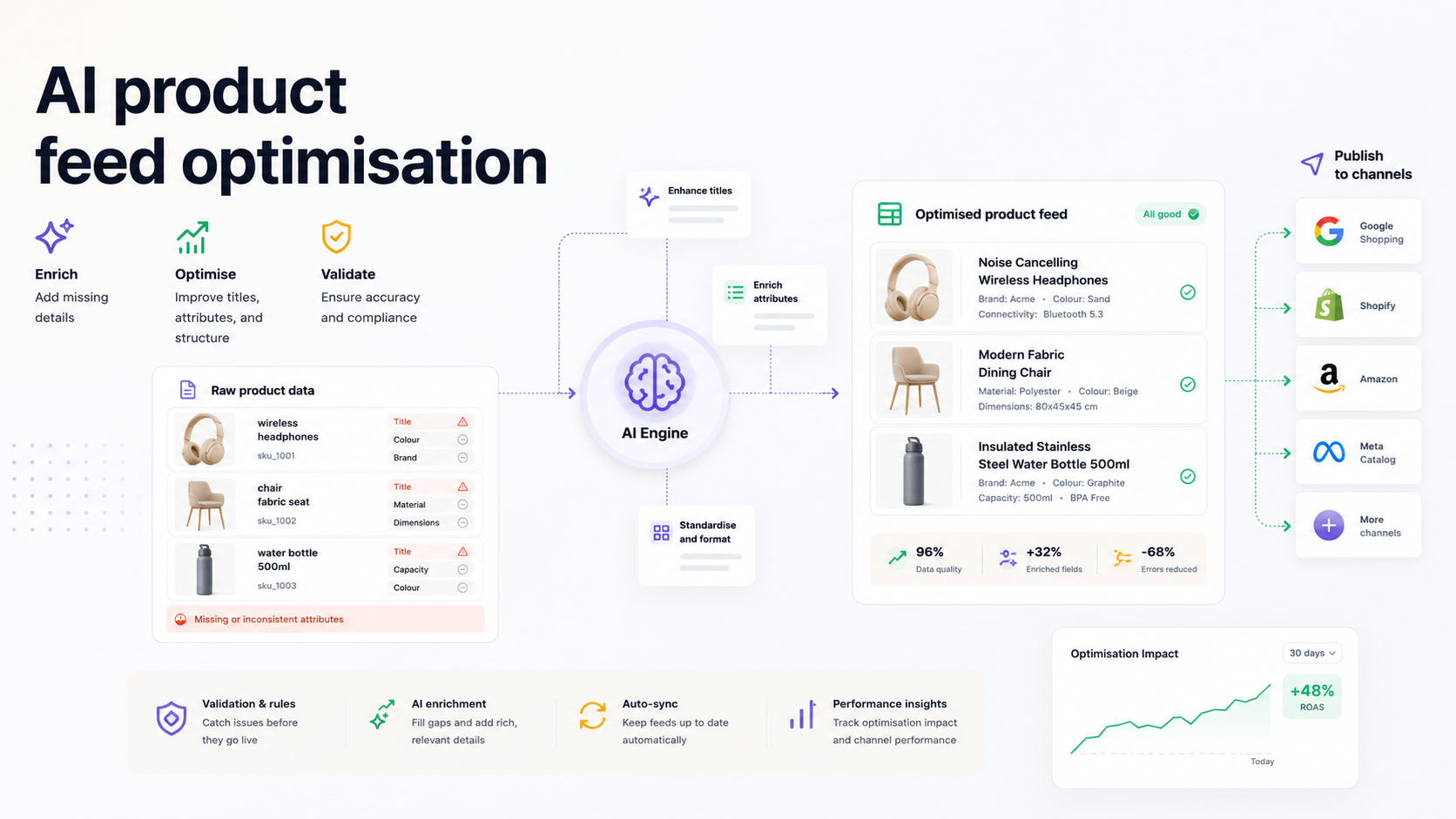 AI product feed optimisation: enrich, optimise, validate, and publish better product data to every channel.
Use it yourself, work with guided support, or ask FeedOps to manage it for you. Automated updates. Feed rules. Order sync alerts and fixes. Product approval support. Feed audits. AI enrichment. Structured experiments across every media channel and marketplace.
Book a demo