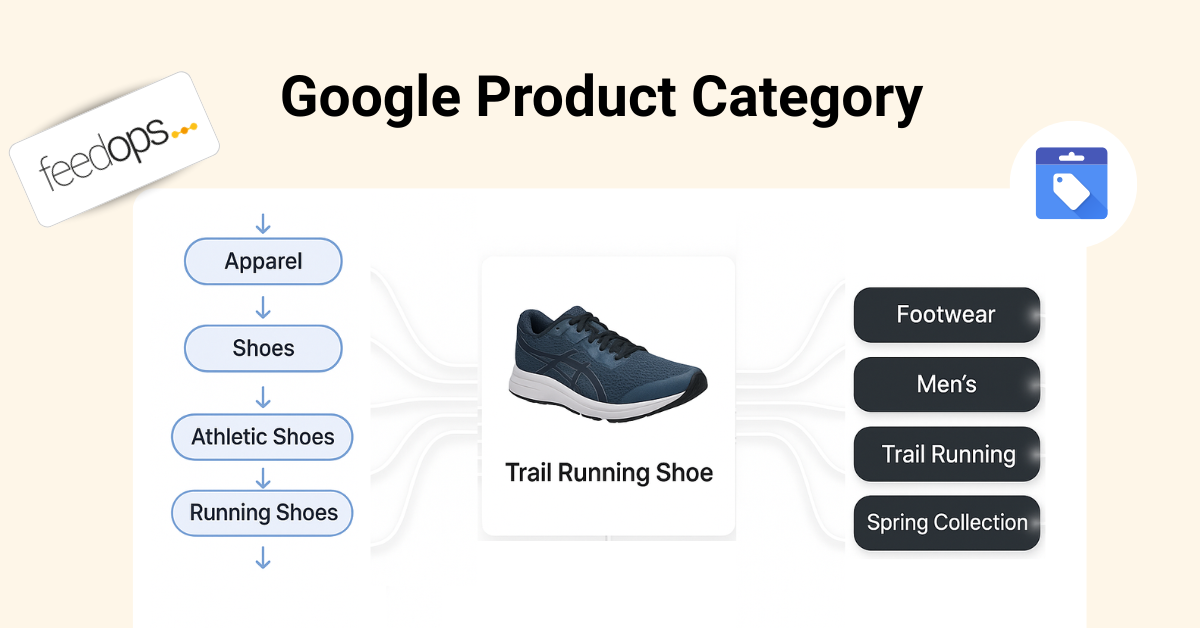
The Google Product Category (GPC) taxonomy is a cornerstone of Google’s global e-commerce infrastructure, serving as a continuously evolving, structured classification system designed to categorize products for the Google Shopping environment. Its primary strategic purpose is to automatically assign categories to products submitted via the Google Merchant Center (GMC), thereby facilitating user search efficiency, improving ad relevance, and enabling structured organization for campaign management in Google Ads.
Table of Contents
Definition, Scope, and Hierarchy of Google Product Categories
Defining the Google Product Category (GPC) Attribute
The GPC is defined by the required google_product_category attribute in product feeds. Although Google’s machine learning systems attempt to assign a category automatically based on high-quality data inputs like titles, descriptions, and GTINs, the attribute allows merchants to override this automatic categorization when necessary. The sheer scale of the taxonomy underscores its detailed nature, comprising between approximately 5,595 and over 6,000 distinct categories, reflecting a commitment to granular product specification across the entire commercial spectrum.
Strategic Role of Product Type in Google Ads
The primary utility of product_type is to organize bidding structures and reporting within Google Ads Shopping campaigns, providing a flexible, merchant-controlled segmentation layer separate from Google’s globally standardized GPC.
FeedOps Insight: Aligning GPC with AI-Driven Precision
FeedOps automatically aligns your Google Product Categories (GPC) with your product data to improve the quality of your titles, descriptions, and product types. This ensures Google can accurately recognize and recategorize your products for better visibility and relevance.
Our platform’s AI-driven feed optimizer, powered by Large Language Models (LLMs), interprets your category logic, product naming conventions, and supporting data—including Product Types—to bridge the gap between how Google understands your products and how you sell them.
The result: more accurate ad targeting, improved campaign performance, and measurable gains in ROAS across every connected channel.
1.2 GPC versus Merchant-Defined Categorization
Why Merchants Need to Understand the Difference
It is essential for merchants to differentiate between Google’s canonical classification and a merchant’s internal system. Understanding this distinction ensures that your product data supports both accurate targeting and effective campaign management.
Google’s Canonical System: The GPC Attribute
The GPC (google_product_category) utilizes the predefined, shared taxonomy managed externally by Google.
For most products, this attribute is optional, as automatic assignment is generally relied upon.
Merchant-Controlled System: The Product Type Attribute
Conversely, the Product Type (product_type) attribute allows merchants to submit their own custom product categorization system.
This system is completely internal to the merchant and often reflects their own website hierarchy (e.g., “Home > Women > Dresses > Maxi Dresses”).
Campaign Strategy: Organizing for Bidding and Reporting
The primary utility of product_type is to organize bidding structures and reporting within Google Ads Shopping campaigns, providing a flexible, merchant-controlled segmentation layer separate from Google’s globally standardized GPC.
SEO Advantage: Embedding Hyper-Relevant Long-Tail Keywords
Beyond campaign structure, product_type is also a strategic way to include hyper-relevant long-tail keywords that may not appear in your standard product titles or descriptions. These long-tail terms give Google a clearer understanding of product intent and search context—helping your listings surface for niche, high-conversion queries.
FeedOps Insight: AI Alignment for Precision and ROAS
FeedOps enhances this process using built-in Large Language Models (LLMs) that automatically detect and expand long-tail keyword opportunities based on your store’s taxonomy, language, and regional audience. This ensures that your GPC and Product Type attributes are perfectly aligned, improving ad precision, discoverability, and measurable ROAS across every connected channel.
Global Taxonomy Structure and Localization Nuances
The GPC taxonomy is a global system, necessitating substantial localization efforts. However, this localization introduces critical architectural considerations for AdTech platforms aiming for multinational deployment.
Localization and Language Availability
The GPC list supports multilingual operations, with the taxonomy available for download in numerous languages, selectable via a localized menu option. This extensive localization is necessary to support global e-commerce activity across diverse linguistic markets.
Fallback Policy for Unsupported Languages
A standard operational policy addresses situations where the taxonomy may not be available in a specific target market’s language. In these cases, AI product optimisation software (like FeedOps) and merchants are explicitly required to use the English category values (the full path) or, preferably, the universal numeric category ID.
Critical Regional Discrepancies (US, UK, AU English)
Despite using the same language foundation, category names often diverge between regional English standards, creating potential complexities for feed management. These localization differences are systematic and must be accounted for in data pipelines.
Differences in Category Naming Across Regions
One common divergence is in high-level label ordering and terminology. For example, a category identified by the numeric ID 178 is listed as “Apparel & Accessories > Clothing” in the United States, but the identical category appears as “Clothing & Accessories” in the United Kingdom feed.
Variations in English Spelling
Paths frequently contain orthographical variations that reflect differences between American, British, and Australian English. These include spelling distinctions such as ‘analyze’ (US) versus ‘analyse’ (UK/AU), or ‘center’ (US) versus ‘centre’ (UK/AU).
Canadian English as a Hybrid
Canadian English often demonstrates a blend of American and British spelling conventions, resulting in unique textual combinations across data feeds.
Impact on Automated Mapping
Although these differences may seem minor to human readers, they can disrupt automated text-based mapping logic if not properly managed or standardized.
The Universal Numeric ID: The Architectural Standard
Importance of the Numeric Identifier
The prevalence of language and regional variation highlights the critical role of the numeric category ID (e.g., 178). This numeric identifier remains the single, consistent reference point across all localized product category lists—regardless of language or regional spelling differences.
Feed Submission Specifications
Technical specifications for feed submission allow merchants to submit either the numeric ID or the full category path, but never both simultaneously. Submitting both is strictly prohibited to maintain system consistency.
Challenges of Text-Based Categorization
Multiple layers of potential textual inconsistency—including language translation, regional label ordering, and spelling variations—make categorization based on full text paths risky. Such an approach introduces technical debt, requiring constant version control across multiple locales.
Advantages of Using the Numeric ID
Leveraging the universal numeric ID eliminates linguistic and spelling risks, ensuring architectural stability and data integrity across global markets.
Recommendation for AI Shopping Feed Optimization Platforms
For this reason, AI Shopping Feed Optimization Platforms should prioritize storing, mapping, and submitting the numeric ID rather than relying on the text-based category path. The text path should be treated only as a human-readable display value, not a technical identifier.
GPC Mandatory Requirements and Compliance Enforcement
While the GPC attribute is largely optional, relying on Google’s automatic classification for most products , its use becomes mandatory in specific, high-stakes scenarios. In these cases, the GPC functions as a crucial compliance gatekeeper and an enforcement mechanism for category-specific rules.
Mandatory Usage Scenarios and Policy Triggers
The google_product_category attribute must be provided when Google requires explicit merchant classification to enforce regulatory policies or specific technical data requirements. This capability effectively serves as an override mechanism for Google’s own machine learning classification model.1
Enforcement of Category-Specific Attributes
Certain product categories, such as Apparel & Accessories, Mobile Phones, or Software, impose mandatory, category-specific data requirements (e.g., color, size, gender). If Google’s automated system incorrectly assigns a product to one of these restrictive categories, the merchant must use the GPC attribute to override the incorrect classification. Providing the correct, appropriate GPC value removes the enforcement of the irrelevant category-specific attributes, preventing unnecessary product disapprovals.
Regulated Goods Compliance (Alcohol)
Products subject to heightened regulatory scrutiny, such as alcoholic beverages, must be correctly categorized for compliance with advertising policies.1 If a product is misclassified, the merchant must use the GPC attribute to enforce the correct category assignment and maintain compliance. The specific required category identifiers include “Food, Beverages & Tobacco > Beverages > Alcoholic Beverages” (ID: 499676) and its relevant subcategories, as well as categories for homebrewing supplies.
Specific Product Configurations (Mobile Phones/Contracts)
Technical Exception for Contract-Based Devices
A technical exception exists for specific offer types, notably mobile phones or tablets sold under a contract or installment plan. In these cases, the price attribute may legitimately be set to 0.
Required GPC Categories for Zero-Price Offers
When the price is set to 0, the merchant must explicitly assign the GPC attribute to one of the following categories:
- “Electronics > Communications > Telephony > Mobile Phones” (ID: 267)
- “Electronics > Computers > Tablet Computers” (ID: 4745)
This ensures that the system correctly interprets the zero price as a valid offer configuration rather than a data error.
GPC as a Mandatory Attribute in Policy-Sensitive Cases
In these policy-sensitive scenarios, the GPC attribute transitions from optional to mandatory, underscoring its role as a high-confidence, merchant-attested data point. This data is essential for enforcing complex policy validation rules within the Google Merchant Center (GMC) processing pipeline.
Role of GPC in Automated Policy Validation
This mechanism acts as a self-declaration trigger that activates specific rule sets within the platform. To ensure compliance, AdTech software should include robust validation logic that:
- Cross-references products against regulatory or technical exception lists (e.g., zero-price offers, alcohol sales).
- Automatically inserts the correct GPC attribute where required.
Ensuring Compliance and System Integrity
By integrating these validations, AI Feed Management Software such as FeedOps can maintain policy compliance, data accuracy, and system resilience across global product feeds.
Strategic Usage in Google Ads Campaign Targeting
Beyond compliance, GPC is a foundational element for structuring and managing paid campaigns. The taxonomy serves as a primary structure for defining Google Shopping Ads campaigns, allowing merchants to create segmented product groups for granular bidding strategies and detailed reporting. The ability to segment product groups based on GPC categories is critical for Google shopping feed optimization, providing advertisers with the necessary control to adjust bids and budgets based on category performance metrics.
Key Table 1: GPC Mandatory & Policy-Sensitive Categories for Compliance
| Category Requirement Driver | Policy Mechanism | Mandatory GPC Attribute Rationale | Example Category & ID |
|---|---|---|---|
| Category-Specific Attributes | Data Quality & Enforcement | Override Google's automatic misclassification to remove inappropriate attribute requirements. | Apparel & Accessories (Varies) |
| Contractual Pricing | Price and Offer Policy | Allows price attribute to be submitted as 0 for contract-based devices. | Electronics > Mobile Phones (ID: 267) |
| Regulated Goods | Alcoholic Beverages Policy | Ensures products are correctly filtered and adhere to local advertising laws. | Food, Beverages & Tobacco > Beverages > Alcoholic Beverages (ID: 499676) |
| Targeting/Bidding Structure | Performance Optimization | Used to reassign products within campaign structures for granular control. | All Categories (Strategic Use) |
GPC’s Role in Core Google Search and Knowledge Infrastructure
The influence of GPC extends far beyond the paid advertising realm of Google Shopping. It contributes significantly to organic search visibility, structured data handling, and Google’s foundational product knowledge systems.
Influence on Organic Search and Rich Results
Role of Structured Data in Google Search
Google Search aims to comprehensively understand webpage content, and structured data serves as the primary method for providing explicit, standardized signals about that content. While the GPC (Google Product Category) attribute is not required under standard Schema.org markup, it delivers a high-quality, canonical product classification that is crucial in defining product identity.
GPC’s Contribution to Rich Results and Enhanced Visibility
When structured data is implemented on product pages, it becomes eligible for rich results across multiple Google surfaces such as Google Search, Google Images, and Google Lens. These rich results present enhanced commercial details—price, availability, and review ratings—directly within search listings, improving click-through rate (CTR) and user engagement.
Merchant Listings and Product Snippets Eligibility
GPC classification strengthens eligibility for two primary rich product features:
- Merchant Listings – for pages offering direct product purchases.
- Product Snippets – for editorial or review-based product content.
Consistent and detailed GPC mapping in the Merchant Center feed acts as a confirmation signal to Google’s organic systems, validating the product identity and boosting organic visibility.
Product Entity Resolution and the Knowledge Graph
GPC as an Entity Resolution Signal
The GPC attribute plays a critical role in Google’s data architecture, functioning as an Entity Resolution Signal. Google’s Knowledge Graph (KG)—a vast structured database of people, places, and things—relies on such signals to organize and connect data.
GPC’s Role in the Knowledge Graph and Product Identity
E-commerce feeds, enriched with precise GPC assignments, serve as vital input sources for the Knowledge Graph. Google’s Entity Reconciliation API uses this information to standardize, merge, and validate product data across billions of nodes. Assigning a canonical global taxonomy via GPC ensures a high-confidence product identity, reducing ambiguity across data systems.
Strategic Impact on SEO and AdTech Integration
This high-confidence classification enhances entity reconciliation, improving Google’s understanding, ranking, and contextual placement of products in organic search.
AdTech platforms that treat GPC merely as a paid media category label overlook its strategic SEO importance. A consistent, well-structured GPC strategy builds synergy between paid advertising and organic search optimization, strengthening both data accuracy and visibility within Google’s ecosystem.
Technical Implementation, Maintenance, and AdTech Best Practices
Integrating and maintaining the Google Product Category (GPC) attribute within advertising technology (AdTech) systems presents distinct technical and architectural challenges. These challenges stem from Google’s distribution model, which relies on static file downloads rather than a dynamic API, requiring custom-built infrastructure for version control, data ingestion, and validation.
GPC Update Cycles and Version Management
Dynamic Nature of the GPC Taxonomy
The GPC taxonomy is continuously evolving, but it does not follow a regular update schedule. Updates typically occur a few times per year, driven by:
- The introduction of new product types (e.g., emerging tech devices).
- The refinement of existing naming conventions.
- The merger or deprecation of outdated categories.
Distribution Method and Access Limitations
From a developer’s perspective, the key architectural constraint is how the taxonomy is distributed.
Google provides access only via downloadable static files — an Excel (.xls) and a plain text (.txt) version.
Importantly, no public or documented Content API endpoint exists for retrieving the current taxonomy or version metadata.
Maintenance Burden and ETL Requirements
Because no API refresh mechanism exists, AdTech software must maintain its own Extract, Transform, Load (ETL) workflows to:
- Download and parse the taxonomy files.
- Validate and ingest data into internal databases.
- Use Unicode UTF-8 encoding for the plain text file to prevent garbled text or data corruption.
This dependency on manual or automated file ingestion creates a significant maintenance overhead for teams managing large-scale, multi-region product feeds.
Taxonomy Change Detection and Version Control
To ensure consistency, robust AdTech platforms should incorporate an automated Taxonomy Change Detection Engine capable of:
- Monitoring Google’s official download locations.
- Detecting version changes and calculating category deltas (additions, modifications, and deprecations).
- Flagging and remapping products tied to deprecated GPC IDs.
Such a system ensures continuous compliance and prevents feed disapprovals resulting from outdated category references.
Technical Submission and Validation Best Practices
Submission Format
When submitting products to Google Merchant Center, a system must send either the numeric GPC ID or the full category path (e.g., “Apparel & Accessories > Clothing > Dresses”) — but never both simultaneously.
Given the risks of localization, the recommended best practice is to use the numeric ID exclusively, as it remains consistent across languages and regions.
Depth Optimization
Developers should assign the deepest and most granular GPC category available.
- Maximum depth: Up to six levels.
- Recommended minimum: Two to three levels for optimal bidding segmentation and ad relevance.
Providing more detailed classification enhances algorithmic precision and ad performance.
Single Category Constraint
Each product is permitted only one GPC category assignment.
For products that could belong to multiple categories, intelligent selection logic should determine the most specific and contextually accurate classification. This maintains feed integrity and maximizes ad relevance.
Content API Usage and Data Synchronization
While GPC taxonomy ingestion is file-based, product updates should leverage the Content API for real-time attribute synchronization.
- The productinputs.patch method allows partial, frequent updates (e.g., price, stock levels).
- Periodic full reinsertions ensure alignment with current Merchant Center requirements and validate all attributes.
Combining static taxonomy ingestion with dynamic Content API updates ensures both structural accuracy and operational efficiency in product data management.
Key Table 3: GPC Implementation and Maintenance Best Practices
| Implementation Area | Technical Best Practice | Rationale |
|---|---|---|
| Data Storage & Submission | Prioritize and use the numeric ID (e.g., 2271) exclusively. | IDs are universally consistent, simplifying localization and ensuring resilience against textual changes. |
| Granularity | Aim for the deepest possible categorization (up to 6 levels), or a minimum of 2-3 levels deep. | Optimizes ad relevance, improves targeting efficiency, and supports granular campaign organization. |
| Update Strategy | Implement automated file parsing logic (for XLS/TXT) and version tracking. | The non-fixed update schedule requires proactive monitoring to prevent product disapproval due to deprecated category IDs. |
| Encoding | When using plain text feeds, strictly enforce Unicode UTF-8 encoding. | Prevents data corruption ("garbled text") during Google’s ingestion process. |
| Submission Limit | Use only one GPC per product. | Adherence to the strict feed specification limit. |
GPC as an Industry Standard — Competitive Cross-Platform Utilization
The Google Product Category (GPC) taxonomy has evolved beyond its initial role within Google’s ecosystem to become a de facto industry standard for product classification across digital advertising and e-commerce.
Modern AdTech platforms designed for multi-channel syndication must account for varying levels of GPC adoption among competitive advertising systems.
Direct Adoption: Microsoft Advertising (Bing)
GPC Integration within Microsoft Merchant Center
Microsoft Advertising (formerly Bing Ads) has explicitly adopted GPC as a core data field in its shopping campaigns. The Microsoft Merchant Center feed specifications formally recognize the googleProductCategory attribute as part of its schema.
Benefits for Multi-Channel AdTech Systems
This direct adoption enables AdTech platforms managing multi-channel campaigns to reuse existing GPC mappings for seamless syndication into Microsoft Advertising. By eliminating the need for proprietary reclassification, Microsoft’s implementation validates GPC’s role as a universal interchange attribute.
Key Insight: The inclusion of GPC by a major Google competitor underscores its status as an essential data standard for cross-platform e-commerce feed syndication.
Optional Integration: Criteo
Criteo’s Acknowledgment of GPC
Criteo, a leader in retail media and performance retargeting, acknowledges GPC as an optional field in its product feed specification (Google_product_category).
Functional Role and Algorithmic Enhancement
While not mandatory, Criteo leverages GPC to improve:
- Ad relevancy algorithms
- Customer search and product matching accuracy
- Campaign classification quality
By incorporating GPC data, Criteo benefits from the structured and hierarchical nature of Google’s taxonomy, enhancing machine learning performance across its ad systems.
Key Insight: Even where optional, GPC provides strategic data enrichment that boosts retargeting precision and feed intelligence.
Proprietary Taxonomies and Mapping Necessity (Meta/Facebook and Amazon)
Meta (Facebook/Instagram) — Proprietary Commerce Catalog
Meta operates its own Commerce Catalog Taxonomy, requiring specific attributes such as gender, size, and color.
- GPC is not natively recognized or required in Meta’s Commerce specifications.
- AdTech providers must implement custom mapping logic—often using third-party categorization tools—to translate GPC data into Meta’s proprietary schema.
Amazon — Internal Node-Based Classification
Amazon utilizes a complex proprietary classification system based on Product Node IDs. Historically managed via XSD category definitions, it is now transitioning to JSON-based feeds.
- Amazon does not recognize or import GPC in its Seller Central or SP-API frameworks.
- AdTech systems must develop custom, bidirectional mapping logic to align GPC categories with Amazon’s internal node structure.
Key Insight: Platforms such as Meta and Amazon necessitate dedicated taxonomy translation layers, making them exceptions to the otherwise broad industry adoption of GPC.
Cross-Platform Implications and Strategic Takeaway
The cross-platform analysis shows that GPC functions as the de facto universal feed taxonomy:
- Microsoft Advertising directly adopts GPC.
- Criteo encourages its optional inclusion for algorithmic gains.
- Meta and Amazon require mapping adaptation due to proprietary systems.
Maintaining accurate GPC data substantially reduces engineering overhead for multi-channel product feed syndication, while enabling data consistency across a majority of digital platforms.
Strategic Imperative: AdTech platforms should treat GPC maintenance as a core data infrastructure function, while allocating resources for specialized mapping logic to handle non-GPC platforms such as Amazon and Meta.
Key Table 2: Comparative Taxonomy Integration Across Major Advertising Platforms
| Platform | Taxonomy Standard Used | GPC Acceptance | Technical Status of GPC Attribute | Mapping Strategy Required |
|---|---|---|---|---|
| Google Shopping | Google Product Category (GPC) | Native/Primary | Mandatory in specific policy/attribute cases; critical for targeting 1 | None (GPC is the source) |
| Microsoft Advertising | GPC (Adopted Standard) | Yes | Direct attribute (googleProductCategory) supported in feed API 18 | Direct Submission |
| Criteo | Criteo Taxonomy | Optional/Recommended | Optional field; utilized for enhanced ad relevance | Recommended Submission |
| Meta (Facebook) | Meta Commerce Taxonomy | No (Proprietary) | Not an official attribute; internal categorization required | GPC-to-Meta Mapping (External Tooling) |
| Amazon | Amazon Product Node ID | No (Proprietary) | Not utilized in core SP-API/Feed specifications | GPC-to-Amazon Node ID Mapping (Dedicated Logic) |
Conclusions and Recommendations
The Google Product Category (GPC) taxonomy is a high-fidelity classification framework essential to both paid e-commerce distribution and organic product knowledge management. This analysis confirms that GPC is not a simple descriptive tag, but rather a strategic data infrastructure tool that governs feed compliance, campaign optimization, and product entity recognition within Google’s ecosystem.
1. Treat GPC as a Core FeedOps Data Standard
For FeedOps teams, GPC must be regarded as a foundational technical attribute, not just a marketing label.
It directly affects:
- Feed approval and disapproval rates
- Campaign segmentation accuracy
- Organic and paid alignment within Google’s Knowledge Graph
Maintaining consistent GPC assignment across feeds ensures cross-channel stability and system-level reliability.
2. Overcome Distribution and Update Limitations
The primary architectural constraint of GPC is its non-API-based distribution and irregular update cycle. FeedOps teams should:
- Implement an automated taxonomy version control system.
- Monitor official GPC file releases (.xls and .txt).
- Detect category additions, modifications, and deprecations in real time.
- Trigger remapping workflows when deprecated IDs appear.
Proactive taxonomy monitoring prevents feed errors, keeps product data compliant, and reduces manual intervention overhead.
FAQs: Google Product Category (GPC) for FeedOps
What’s the difference between google_product_category and product_type?
- GPC = Google’s canonical taxonomy; used for policy, eligibility, targeting.
- Product Type = your custom taxonomy; used for bidding structure, reporting, and extra keywords.
Can I export Google’s assigned categories to use on other platforms?
Not directly. Google shows you the assigned categories, but they don’t export in your feed file. However, FeedOps automatically maps and assigns your Google Product Categories across Meta, Microsoft, Pinterest, TikTok, and more, saving you the manual setup.
What’s the difference between google_product_category and product_type?
- Google Product Category: A standardized taxonomy defined by Google.
- Product Type: Merchant-defined, flexible, and also used by Google as an additional relevance signal. It also helps advertisers with segmentation and reporting.
What happens if I leave product_type blank?
Your products can still run, but you lose both a relevance signal for Google and a powerful lever for campaign structure and reporting. It’s a missed optimization opportunity.
How deep should our GPC categorization go?
Minimum: 2–3 levels. Ideal: as deep as available (up to 6 levels). Deeper = better targeting and eligibility.
Is GPC mandatory?
Usually optional, but mandatory in policy-sensitive scenarios (e.g., alcohol, contract phones/tablets with price = 0, categories with required attributes like apparel).
What if Google auto-classifies my item into the wrong category (e.g., apparel) and demands irrelevant attributes?
Override with the correct GPC to remove irrelevant attribute requirements and avoid disapprovals. This is easily done in FeedOps.
Does GPC help SEO or only Ads?
It supports rich results eligibility and entity resolution via consistent product identity signals—indirectly boosting discoverability and CTR.
Do Microsoft Advertising and Criteo use GPC?
Microsoft Advertising: Directly adopts googleProductCategory.
What about Meta (Facebook/Instagram) and Amazon?
- Both use proprietary taxonomies. Plan mapping layers:
- GPC → Meta Commerce attributes
- GPC → Amazon Product Node IDs
- GPC → Meta Commerce attributes
How does GPC relate to GTIN?
GTIN identifies the exact product; GPC classifies the type/category. Use both for best precision and eligibility.
How should we classify variants (size/color)?
Variants share the same GPC; variant attributes live elsewhere (size, color, etc.). Keep GPC consistent across variants.
Can we submit multiple GPCs for a multi-use product?
No. One single, most specific GPC per product. Use business rules to choose the best fit.
What’s the recommended fallback when a local language taxonomy isn’t available?
Use English path for display if needed, but submit/store the numeric ID as the canonical source of truth.
Should we use Custom Labels or Product Type instead of GPC for bidding?
Use GPC for canonical classification, Product Type and Custom Labels for bidding segmentation and testing. They complement, not replace, GPC.
How does FeedOps help here?
Automates GPC alignment, detects taxonomy deltas, remaps deprecated IDs, and uses LLMs to align Product Type and long-tail signals—boosting relevance, policy compliance, and ROAS.
How do Google Product Categories (GPC) affect Local Inventory Ads (LIA)?
The Google Product Category (GPC) attribute plays a critical role in Local Inventory Ads (LIA) because it enables Google to correctly understand and classify in-store product availability. Accurate categorization ensures that:
- Your local inventory feed aligns with Google Merchant Center’s taxonomy.
- Products appear in relevant local shopping results, especially for “near me” and map-based searches.
- Store pickup options, local availability labels, and price comparisons display correctly in search and Maps.
For FeedOps teams, this means:
- Ensuring consistent GPC assignments across both online and local feeds.
- Making sure each store feed product references the same numeric GPC ID as the master product catalog.
- Monitoring policy-sensitive categories (e.g., alcohol, mobile devices under contract) for local compliance.
Best Practice: Treat the numeric GPC ID as the canonical link between your primary product feed and your Local Inventory Ads feed to maintain consistency and compliance.
👉 See the Local Inventory Ads setup guide on developers.google.com.